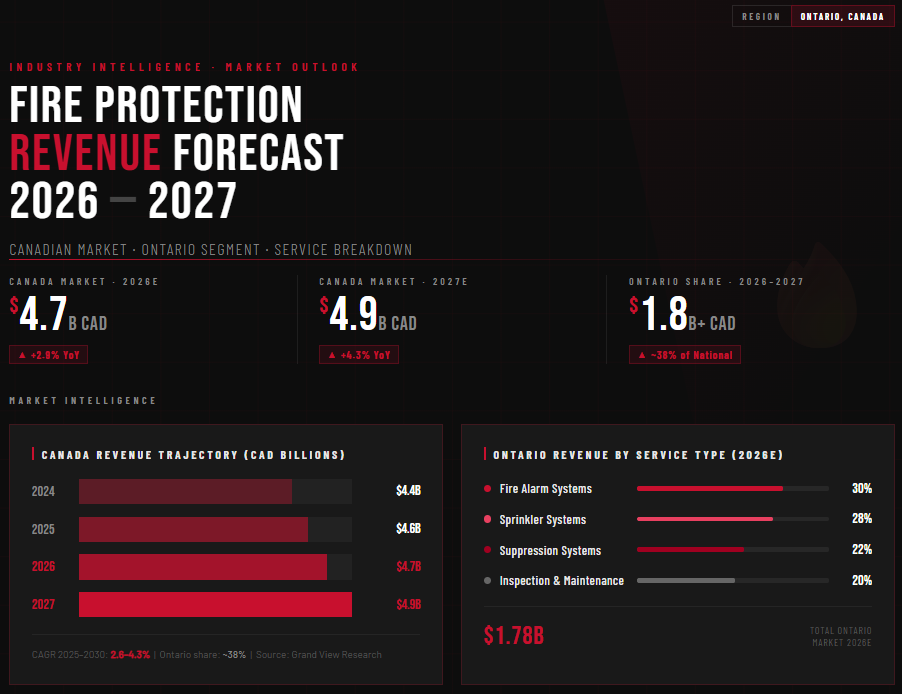
The Canadian fire protection sector is experiencing a period of unprecedented growth and regulatory evolution. According to recent market intelligence data, the national fire protection market is on a direct trajectory to hit $4.9 Billion CAD by 2027.
For industry stakeholders, contractors, and building managers, staying ahead of this curve isn't just about capturing market share—it’s about absolute compliance in a tightening regulatory environment.
The Ontario Market: A $1.8 Billion Powerhouse
Ontario continues to lead the national momentum, commanding a massive $1.8+ Billion CAD share of the projected 2026–2027 market. Driven by strict regional mandates and a dense infrastructure footprint, the province is seeing distinct patterns in how fire protection revenue is distributed across service sectors:
Fire Alarm Systems (30%): Leading the pack, driven by technological upgrades and code compliance.
Sprinkler Systems (28%): Closely following as mandatory installations expand in both residential and commercial sectors.
Suppression Systems (22%): Crucial for specialized, industrial, and high-hazard commercial environments.
Inspection & Maintenance (20%): The recurring foundation of the industry, ensuring system reliability and life safety compliance year-over-year.
The High Cost of Non-Compliance: New OBC Requirements & AMPs
The financial growth of the sector is closely tied to strict updates to the Ontario Building Code (OBC). Regulatory bodies, including the Technical Standards and Safety Authority (TSSA), are emphasizing proactive safety.
Critical Update: New OBC mandates introduce stricter rules, including mandatory alarms in critical spaces. Furthermore, Administrative Monetary Penalties (AMPs) have escalated sharply—reaching up to $500,000 for severe non-compliance.
With penalties of this magnitude, the margin for error has effectively dropped to zero. Property owners and developers must lean heavily on certified fire protection professionals to audit, upgrade, and maintain their assets properly.